
 VideoProc Converter AI
 New AI features are available



 Listed in
 Dealing with noisy or slightly blurry photos is a common challenge for photographers. AI photo enhancement software aims to solve this, and Topaz Photo has been a key player in this space.
When Topaz Photo AI first arrived on the scene in September 2022 (starting around v0.1), the market for AI photo tools was still quite new, and AI photo enhancers were relatively uncommon. For a significant period, it was widely regarded by many photographers and professionals as the leading AI photo enhancer, as most people still relied on traditional methods.
However, fast-forward to 2025, and the competitive landscape is unrecognizable. AI video and image enhancement tools have become ubiquitous. In this crowded market, Topaz has updated its offerings, rebranding "Topaz Photo AI" to "Topaz Photo" and claiming it to be more powerful than ever. Yet, this evolution comes with a significant price hike. The company has transitioned from a perpetual license to a more expensive subscription model, costing $199 annually as a standalone program or $399 annually when bundled within the Topaz Studio subscription—a price point many find exorbitant.
This brings us to the big question: in a market saturated with AI photo enhancers, and especially when you consider its drastically shifted, premium pricing, is Topaz Photo still the best value and the right choice for photographers today? In this review, I'll share my thoughts after testing it in real-world use.

Heads up: Topaz has switched to a subscription model with Topaz Studio, and now you’ll be paying $199/year instead of a one-time fee of $199 for Photo AI. If you're looking for a more affordable option, VideoProc Converter AI offers excellent value at just $39.95 per year or $65.95 for a lifetime. It provides powerful AI-driven enhancements for video, images, and audio, along with a comprehensive media processing toolkit.
What Is Topaz Photo
Topaz Photo is software designed to help photographers quickly enhance their image quality. It's developed by Topaz Labs, a company renowned for its specialized photo enhancement tools.
Previously, users of Topaz software might have utilized separate applications for different tasks:
- DeNoise AI: For reducing grain and noise in images.
- Sharpen AI: For increasing image sharpness.
- Gigapixel AI: For upscaling images to larger sizes.
Launched on September 15, 2022, Topaz Photo revolutionized usability by merging the powerful capabilities of DeNoise AI, Gigapixel AI, and Sharpen AI into a single, integrated software. Now, as of 2025, Topaz Photo has become even more capable, incorporating a range of new features. These include presets for quick adjustments, flexible ordering of enhancements, and the ability to adjust RAW color and lighting.
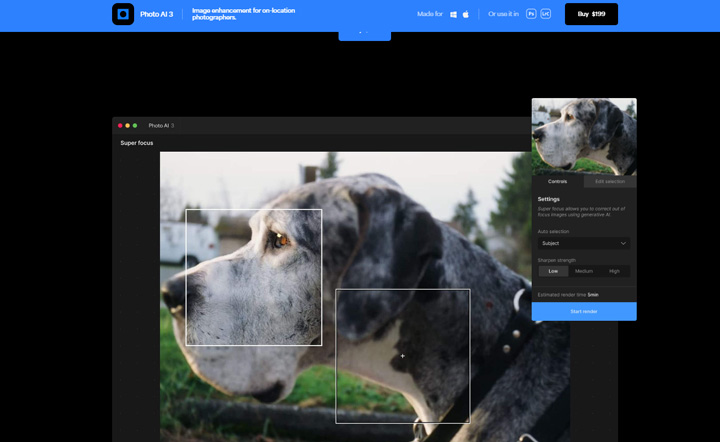
Key Features
Topaz Photo is packed with features designed to address common image quality problems, all powered by AI. Let's break down the core functionalities:
| Feature Name | Description |
|---|---|
| Core Image Enhancement |
Denoise: Reduces noise/grain in photos; Allows to set the reduction levels and detail recovery. Sharpen: Enhances clarity and detail by correcting various types of blur (motion, lens, focus). Upscale: Increases image resolution up to 16x using AI to generate new details. Face Recovery: Enhances the human faces with the "Realistic" and "Creative" options. Remove Object: Remove unwanted objects with the context-aware algorithm. Super Focus: Fixes blur and extracting detail in challenging situations. Adjust Lighting: Corrects underexposed/overexposed areas and adjust the color balance. |
| Workflow and Integration |
Stacked Actions: Allows applying multiple enhancements in any desired order within one photo. Subject Masking: Creates masks around the main subject in an image for targeted enhancements. Batch Processing: Enables applying edits and enhancements to multiple images simultaneously. Plugin Integration: Also works as a plugin for Adobe Photoshop/Photoshop Elements/Lightroom. |
How About Its Performance in Practice
To see how well Topaz Photo performs its key functions, I ran several tests using different images and settings, focusing on its quality enhancement capabilities.
1. Autopilot
Original Image: An AI-generated portrait that appeared blurry due to low resolution. Settings: Applied AutoPilot, allowing Topaz Photo to automatically select the best settings for this specific image.
Looking at the default preview size, I could see some improvement in the picture quality, but it wasn't overly dramatic.
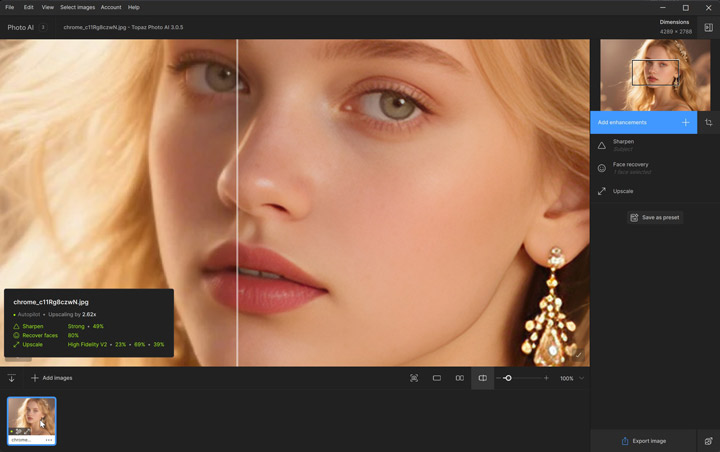
A closer look revealed a wealth of restored detail: the earring was now perfectly clear, lip lines were crisply defined, a faint mole on the neck was distinctly visible, and fine textures on the dress strap emerged. The overall effect was a much cleaner and more detailed image, with only the slightest hint of softness to betray the heavy AI processing it had undergone.
2. Deblur + Face Restore + Upscale (High Fidelity)
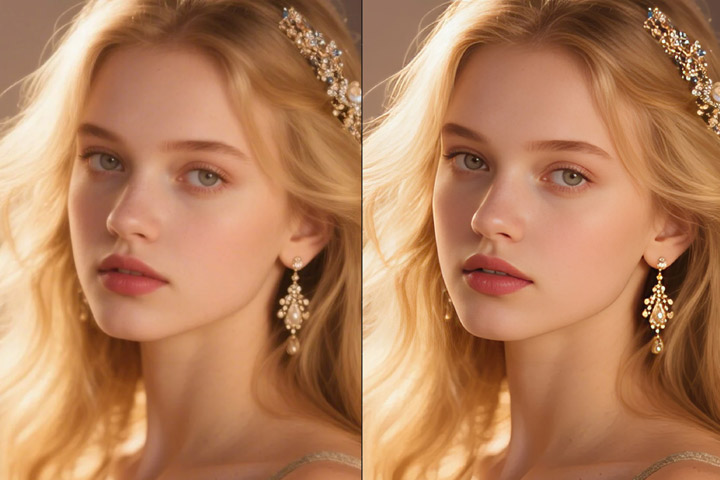
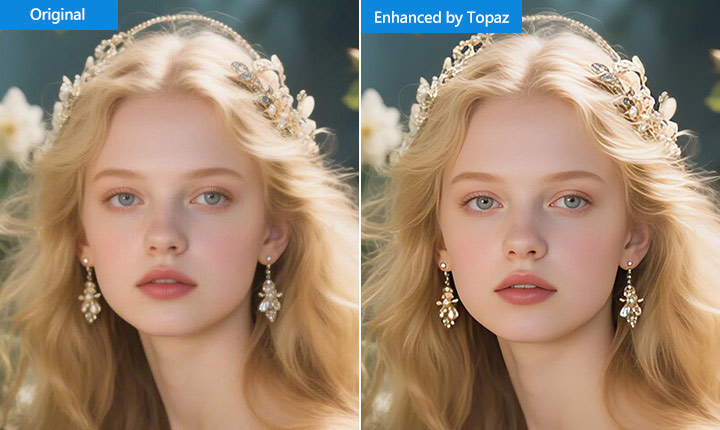
Original Image: A blurry AI-generated portrait. Settings: Applied 4X Upscale using the High Fidelity (v2) model and enabled Face Restore. Other settings were left at their default values.
Viewing the result at window size showed a dominant improvement in the overall picture quality.
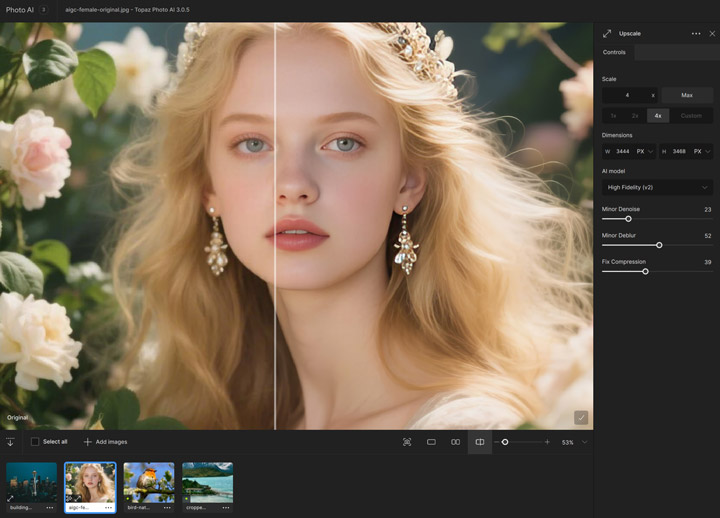
However, upon closer inspection, I noticed some loss of fine detail in areas like face texture, hair, and other intricate details. The enhanced image also still felt a bit blurry in certain areas.
3. Denoise Image + Upscale (Low Resolution AI Model)
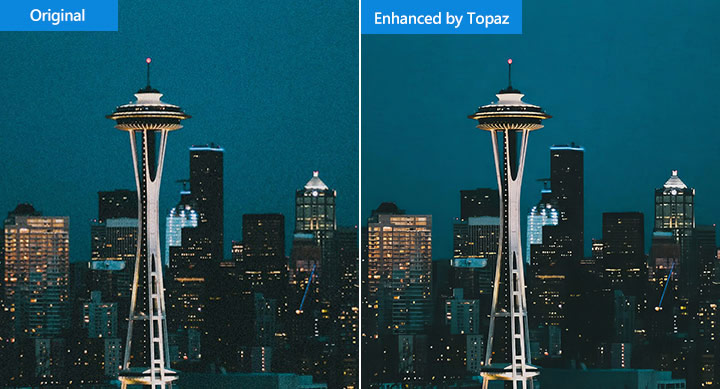
Original Image: A photograph of a building taken at night, which was quite noisy. Settings: Used Max Scale with the Low Resolution AI model. Minor Denoise was set to 74 and Minor Deblur to 37.
Overall, I was very satisfied with the outcome. It perfectly addressed the noise issue while successfully preserving details.
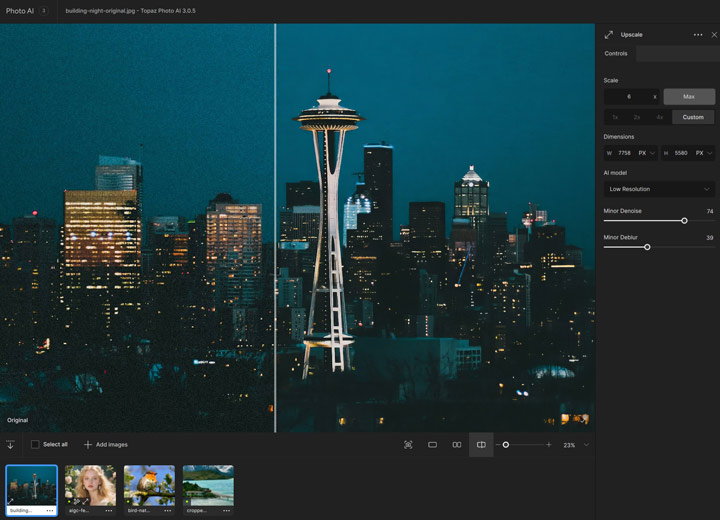
Magnifying the image to inspect details further confirmed the good result, though I did notice some small artifacts. For example, the very edges of the building had a blurry, band-like artifact layer.
4. Denoise + Upscale (Standard V2 AI Model)
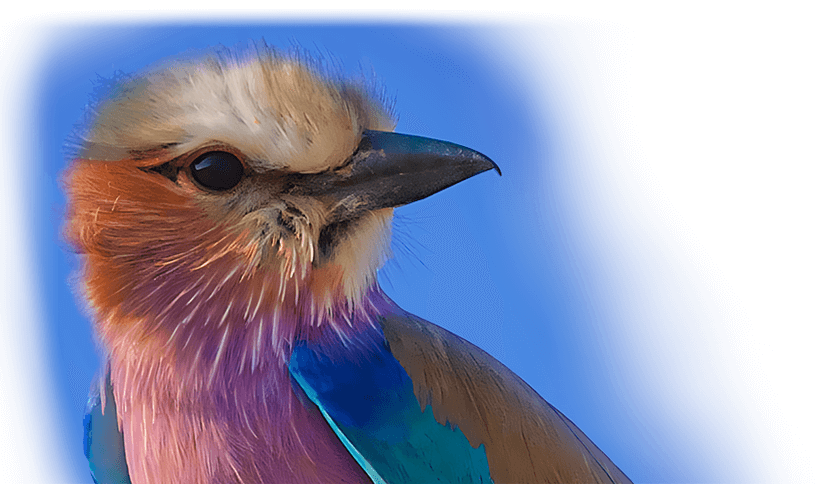
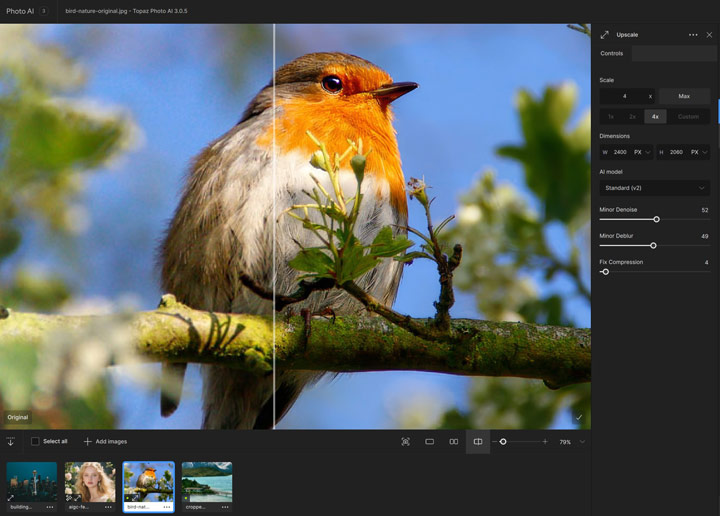
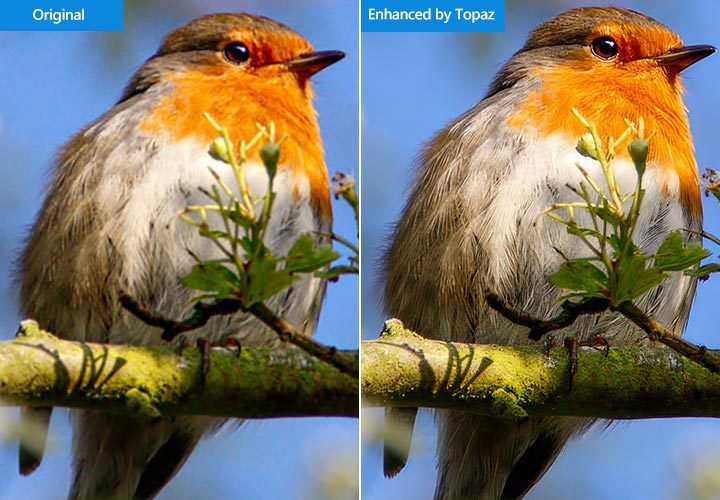
Original Image: The bird image, which was a bit noisy and not very clear due to the lighting conditions. Settings: Applied Max Scale using the Standard (v2) AI model. Other settings were left at default.
Previewing the image at the size that fit the window looked very good. The feathers appeared quite clear, and details on the branches were well preserved and restored.
Zooming in showed excellent detail restoration in the feathers, particularly in the tail section. The original image was very blurry, but the restored feathers looked incredibly natural, just as I would have imagined the details to be. The branches and the green on them were also vividly and accurately restored.
5. Upscale(Graphic AI Model)+ Sharpen
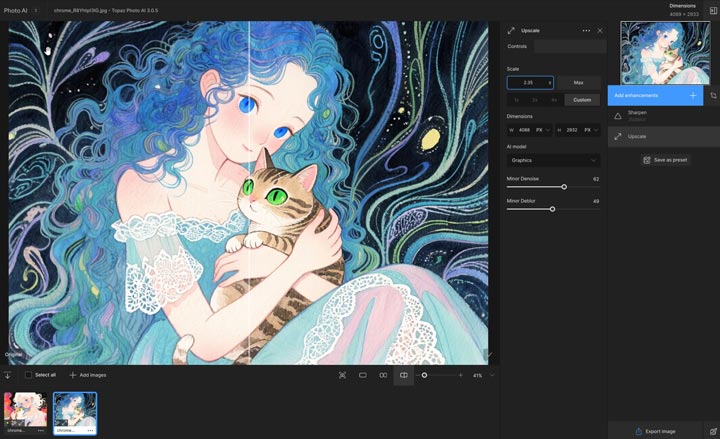
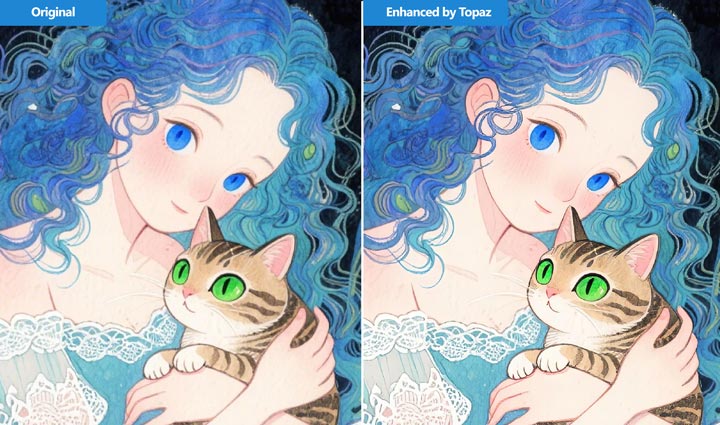
Original Image: A graphic illustration-style image created by AI. I used a screenshot of a portion of it, which was low quality and blurry due to an unwanted watermark from a free account. Settings: Upscaled using the Graphics AI model and applied Standard Sharpen. Other settings were left at default.
The overall improvement wasn't very noticeable at first glance.
However, taking a close look revealed significant clarity improvements. The eyes of both the person and the cat became clear from their original blurriness, hair strands were sharp, and lace details on the dress were well restored. Overall, the effect was quite good for this type of image.
How Much Does Topaz Photo Cost
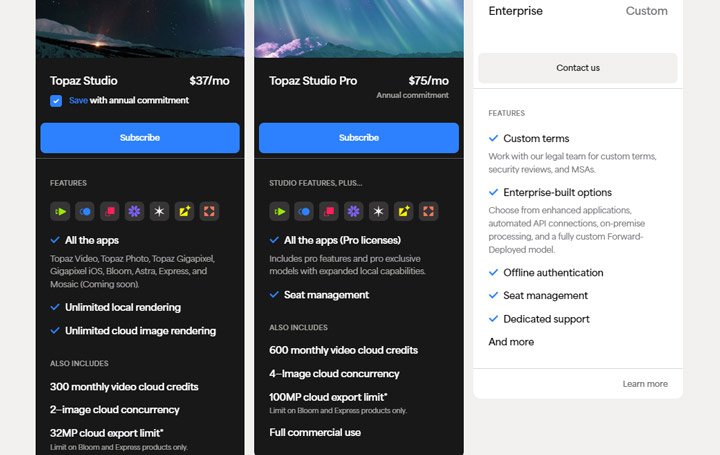
Not long ago, Topaz Photo used to follow a perpetual license model. You paid once ($199) and owned that version forever. If you wanted updates after the first year, you could renew your upgrade plan for $99–$119 per year. It wasn't cheap, but at least it felt like a one-time investment that you could control.
Recently, however, Topaz has switched entirely to a subscription-based system, and many users feel the pricing has become even steeper and less flexible. Now, it comes in a subscription mode, costing $199 annually, meaning you no longer own the program outright. You can also subscribe to it through Topaz Studio, which bundles every Topaz app into one package. However, that's even more pricey – $399 per year! This shift from ownership to a recurring fee has left many photographers feeling the pinch.
| Plan | Price | Includes |
|---|---|---|
Topaz Photo (Standalone) |
$199 per year |
Only supports upscaling and enhancing photos |
Topaz Studio |
$399 per year |
Photo AI, Video AI, Gigapixel AI, Bloom, and more. |
Topaz Studio Pro |
$799 per year |
Photo AI, Video AI, Gigapixel AI, Bloom, and more. |
System Requirements: Will It Work for You
Before you dive into using Topaz Photo, it's important to check if your computer has the necessary power. Like many advanced AI-driven programs, Topaz Photo can be quite demanding on your hardware to perform its tasks efficiently. Here are the minimum and recommended system specifications you'll need for both Windows and macOS:
| Operating System | Requirement Type | CPU | System RAM | Graphics Card (Windows) / Video RAM (Mac Intel) | CPU & Graphics Card (Mac Apple Silicon) |
|---|---|---|---|---|---|
| Windows | Minimum | Intel or AMD, with AVX instructions, released after 2013 | 16GB | NVIDIA GTX 980 Ti or higher (6GB VRAM) OR AMD Radeon 570 or higher (6GB VRAM) | N/A |
| Windows | Recommended | Intel or AMD, with AVX instructions, released after 2020 | 24GB | NVIDIA RTX 20 series or higher | N/A |
| macOS | Minimum | Intel with AVX instructions | 16GB | 6GB Video RAM | Apple Silicon processors |
| macOS | Recommended | (Intel: Not explicitly stated, likely newer Intel with AVX) | 24GB | (Intel: Not explicitly stated, likely higher VRAM) | Apple Silicon M2 or higher |
Notes:
Beyond the core components, you'll also need sufficient space on your hard drive for installation and program data. Topaz Photo requires approximately:
- Windows: Around 34.7GB (this includes program files and data that can vary slightly based on your GPU).
- Mac: Approximately 9GB.
Given these requirements, particularly the need for a good amount of RAM and a capable graphics card, Topaz Photo might not run optimally, or even at all, on less powerful computers. If your current system doesn't quite meet these specifications, or if you're looking for a less resource-intensive alternative that still offers AI enhancement capabilities, a lightweight option like VideoProc Converter AI could be a much better fit.
Pros & Cons of Topaz Photo
Pros of Topaz Photo
 Remarkable AI Enhancement Quality: This is arguably where Topaz Photo shines brightest. Its AI models are exceptionally good at tackling common image problems like noise and blur. The detail recovery and noise reduction are genuinely impressive.
Streamlined All-in-One Workflow: Have noise reduction, sharpening, and upscaling capabilities combined in a single application. This eliminates the need to open multiple programs or use different plugins, significantly simplifying and speeding up the post-processing workflow.
User-Friendly Interface and Automation: Topaz Photo is designed with ease of use in mind. The interface is clean and intuitive. The "Autopilot" mode, while not perfect for every image, provides a fantastic starting point and can handle basic enhancements with a single click, making powerful AI tools accessible even to beginners.
Effective for Large Projects: Batch processing is a significant time-saver for large volumes of photos. Features like prefix/suffix naming for easy organization and a visual processing queue to monitor progress help you manage your output efficiently.
Cons of Topaz Photo
 Can be resource-intensive and slow on less powerful computers.
The Autopilot mode may not always produce optimal results for all images; manual adjustments might be needed.
The cost is high, and free updates for new AI models are only included for the first year.
Potential for occasional artifacts or unnatural look if overused.
Lack the support for colorize faded photos.
Need additional cost for enhance and upscale videos.
User Feedback from Topaz Photo
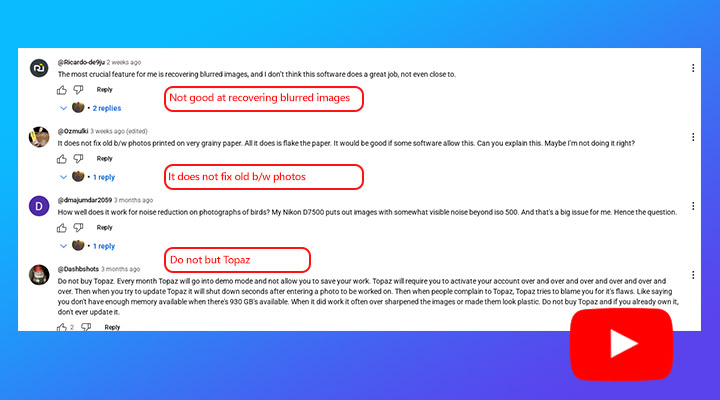
Topaz Photo generally receives positive user ratings. However, not all feedback is positive. Some users have noted performance issues, particularly with slower processing times when using features like upscaling. Beyond performance, specific user comments reveal a range of criticisms regarding the results themselves. Here are some examples of feedback from users:
1. Unimpressive results noted
"I've seen many many ads for TopazAI to denoise, sharpen, and upscale images. But when I tried the free trial version I was fairly unimpressed with the results (apologizes I don't have access to them at this time)." - by @Harmee-kun from reddit.com
2. Unnatural look reported
"I as impressed first, but pretty soon found the results fake and plasticky, it creates aliens. Stopped using it or do it to frighten people." - by @Terrible_Snow_7306 from reddit.com
3. Questionable value proposition
"After looking at the results of the various "filters" I really don't see this software being worth $200. Even though I am still working with an old version of Photoshop (CS6) and using three old Topaz filters (actually "antique" in computer years); DeNoise, Clarity and very occasionally" - by @rogerbeltz2370 from YouTube.com
4. Significant detail loss
"The face of the man lost a lot of definition. I think the original looked much better even with the noise. I tried the free demo and thought it did a horrible job." - @dougharder6258 from youtube.
Best Alternative to Topaz Photo: VideoProc Converter AI
While Topaz Photo offers powerful photo enhancement, it might not be the right fit for everyone, especially considering its cost, system requirements, or its focus solely on images. If you're looking for an alternative that addresses these points, VideoProc Converter AI is a strong contender worth considering.
Highlight Features:
- AI upscale and enhance photos, colorize old faded pictures, and restore faces.
- Boast AI-driven video features: super resolution, stabilization, frame interpolation, etc.
- Fix grain, noise, and other imperfections with original and even better details.
- Optimized performance and faster processing speeds even on mid-range computers.
- All-in-one media toolkit: edit, convert, compress, record, and download videos.

Topaz Photo vs VideoProc Convertert AI (Side by Side Comparison)
Let's put them head-to-head to see how Topaz Photo and VideoProc compare:
| Feature | Topaz Photo | VideoProc Converter AI |
|---|---|---|
| Main Focus | Dedicated Photo Enhancement | Versatile AI Media Enhancer & Converter (Photos, Videos, Audio) |
| AI Capabilities | Photos: Upscale, Enhance, Face Restoration. Videos: No AI features. Audio: No AI features. |
Photos: Upscale, Enhance, Face Restoration, Colorize. Videos: Upscale, Enhance, Stabilize, Frame Interpolation. Audio: Remove Noise. |
| Performance | Can be resource-intensive, potentially slow on less powerful or older systems. | Highly efficient, fast processing, performs well even on mid-range computers. |
| Price | Anual subscription fee: $199 (as a standalone program) or $399 (as part of Topaz Studio) | Lifetime license: $65.95 (or annual licenses: $39.95) |
| User Interface | Streamlined specifically for photo editing. | User-friendly interface designed for both video and photo tasks. |
Topaz Photo vs VideoProc Converter AI (See Our Test Result)
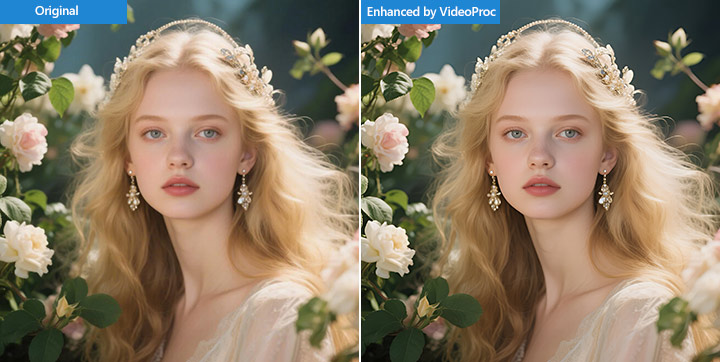
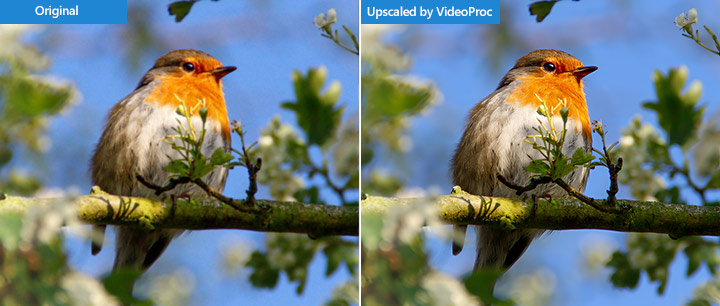
See the impressive results when VideoProc Converter AI is used to enhance photos.
1. Upscale AI Generated Images
2. Upscale Photography with Rich Details
3. Enhance Noisy Photography
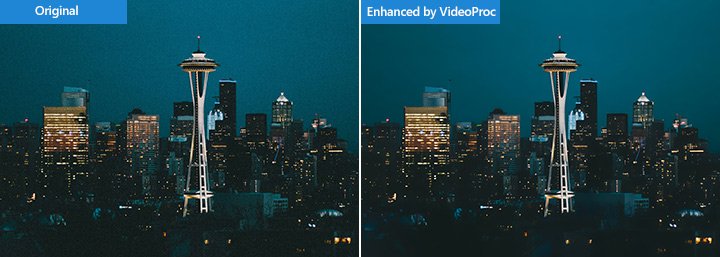
4. Colorize Faded Photos
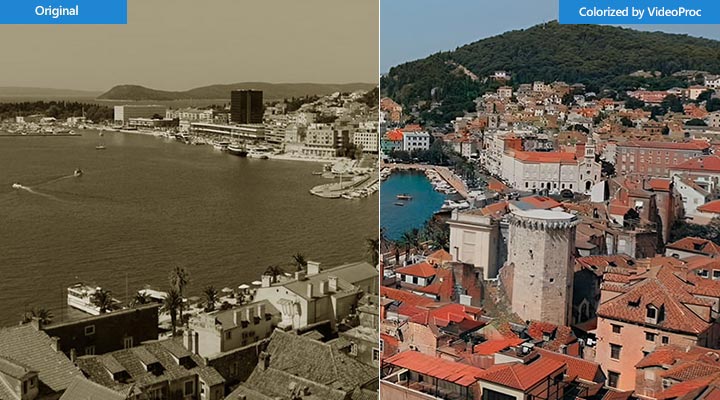
5. Restore Face(s)
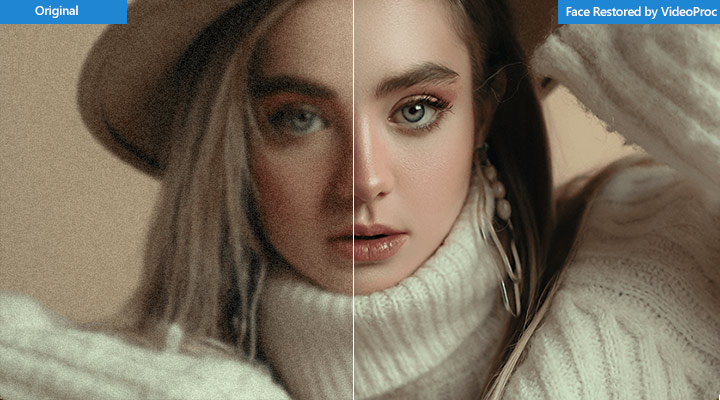
Ready for the best alternative to Topaz Photo? Download and install VideoProc Converter AI free.
Conclusion
In summary, Topaz Photo is a powerful AI tool specifically for photo enhancement, excelling particularly in noise reduction, sharpening, and upscaling with a straightforward interface. It's a solid choice for photographers whose primary focus is dedicated AI photo quality and a streamlined workflow, especially if they are already using other Topaz products. However, if you need a more versatile software solution that performs efficiently on a wider range of computers and handles both photo and video processing with a balance of AI and manual control, VideoProc Converter AI presents a compelling alternative. Ultimately, your decision comes down to your specific needs: Topaz Photo is excellent for pure AI photo power if your budget and system allow, while VideoProc Converter AI offers broader capabilities and efficiency for users working with both photos and videos.